Straight answers from an electrician in North London.

The survey says the fuse box is old. How worried should I be?

Tell us what the survey says about the electrics and your postcode. We pass it to an electrician who works in Barnet, so you can ask what is a danger and what can wait before anybody quotes for a new board.

Key information

  • Old is not a finding. A standard survey does not test the electrics at all, so the surveyor is telling you to get an inspection, not telling you there is a fault.
  • Rewireable fuses are listed under Myths in the electrical industry's own best practice guide. They are not a non-compliance and do not need reporting.
  • A plastic consumer unit in an existing home is not a fault. That rule applies when a board is replaced, not retrospectively.
  • There is no legal requirement to upgrade an existing installation to current standards. Nobody can make you.
  • Free first step: tell us what the survey says and we will pass it to an electrician.
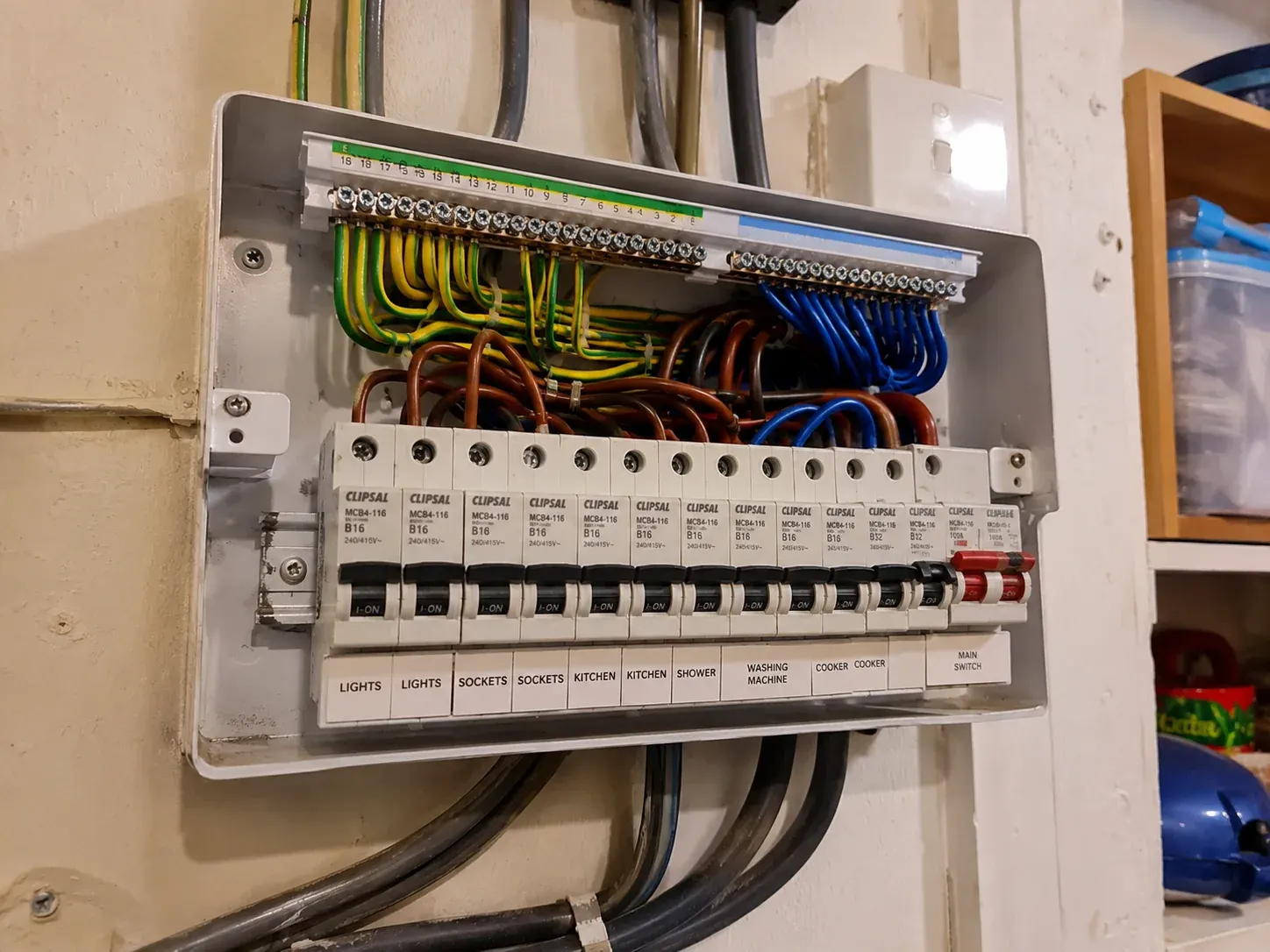
A consumer unit fitted by Fosters Electrics with the cover off and every circuit labelled
A board Aaron fitted in North London. The circuits are labelled because the next person to open it should not have to guess.
First step
Free enquiry
Reply time
We reply by email, usually within one working day.
Who answers
Aaron Foster, Fosters Electrics
Patch
NW, N, HA, EN, WD and around

The three questions people arrive with

Verdict first, reasoning second. If you are on a phone late at night, the first line of each card is the answer.

Is my house dangerous?

Almost certainly not because the board is old. Age is not a defect. The industry's own best practice guide is explicit that installations built to earlier editions of the wiring regulations may not comply with the current one in every respect, and that this does not necessarily mean they are unsafe for continued use or need upgrading. What matters is specific findings, not the date on the casing.

Am I legally required to change it?

No. The Electrical Safety First best practice guide says it in those words: there is no legal requirement that calls for an existing installation to be upgraded to current standards. Replacing a consumer unit is notifiable work that has to meet today's standard, but choosing not to replace it is not an offence and does not make your house unlawful.

What should I spend and in what order?

An inspection first, then anything coded C1 or C2. Get a report that codes what it finds. Deal with anything coded C1 straight away and anything coded C2 as a matter of urgency. Anything marked FI needs further investigation. Then consider shock protection. Items coded C3 are improvements and can wait. The guide price in a Which? survey of its Trusted Traders is £100 to £330 plus VAT for a report on a three-bedroom semi. A new fuse box is £500 to £1,500 plus VAT. Which? says London prices are likely to be at the upper end. Compliance with the latest edition for its own sake comes last, if at all.

Warning signs worth checking now

Things you can look at in the next five minutes, with no tools.

Look for a Test button

A button marked Test or T on the board means you have an RCD, the device that protects a person from an electric shock rather than protecting the cable. No Test button usually means the finding is an improvement recommendation, not a danger.

If there is an RCD, press Test

It should cut the power to the circuits it protects, and then reset. Expect to reset some clocks. If it does not trip, or will not reset afterwards, that is a genuine finding and worth an electrician's attention.

Look at the front of the board for heat

Scorching, browning, melted plastic around a fuse holder, a smell of hot bakelite, or a missing breaker leaving an open hole with live parts behind it. These are the danger signals. Not the age.

Look at the back and the switches

A wooden backboard, cast iron switches, or a haphazard mixture of several fuseboxes added over the years. Electrical Safety First lists these as signs the installation may be over 40 years old and may need rewiring. That is a different and bigger conversation than the board.

Photograph the pipes near your stopcock

Look for a green and yellow cable clamped to the incoming gas and water pipes near the meter and stopcock. Whether that bonding is there is one of the most useful things to tell an electrician before they quote.

Look for round pins and bathroom switches

Round-pin sockets, round light switches, braided flex hanging from ceiling roses, brown or black switches mounted in skirting boards or a light switch on a bathroom wall. They point to old wiring. Ask for them to be looked at in an inspection.

If more than one of these sounds familiar, tell us what you can see.

Why this happens

Most cases come down to a short list. The job is to work out which, and to rule out the ones that matter.

The board simply predates RCDs

A board from the 1980s to the 2000s with circuit breakers and no RCD, or a 1960s one with rewireable fuses. By a distance the commonest thing behind the phrase the fuse box is old. On a report this codes as improvement recommended for ordinary indoor circuits.

What to do: Worth improving, particularly with children in the house or if you use garden equipment. Not an emergency, and not a reason to lose sleep.

The enclosure is plastic

The requirement for non-combustible enclosures came in for new work from 1 January 2016. It is not retrospective. On an inspection today a plastic board is normally not even recorded, unless it sits under a wooden staircase or in your only escape route.

What to do: Nothing, in most homes. Ask which code the report gives it before you pay for anything.

Bonding to gas and water is missing

Main protective bonding connects the incoming metal gas and water pipes to the earthing system. Missing bonding is potentially dangerous (C2). So is a bonding cable under 6 mm² or one with heat damage.

What to do: This is the one to fix. It is usually a short, low-cost job, and it often turns an unsatisfactory report satisfactory on its own.

A bathroom or outdoor circuit with no RCD

Shock protection matters much more where water and bare feet are involved or where a lead runs out to the garden. A socket in a bathroom or one used for outdoor equipment with no RCD is potentially dangerous (C2). Other bathroom circuits with no RCD are an improvement recommendation (C3) where the extra bonding is satisfactory.

What to do: Ask specifically whether protection can be added without replacing the whole board. Often it can.

A board that has grown over the years

A main board with a sub-board bolted alongside it and some DIY additions. Electrical Safety First calls this a haphazard mixture of fuseboxes, and it is the classic route to a missing blank and an exposed conductor.

What to do: Worth consolidating. This is a case where replacing the board really is the right answer rather than a sales pitch.

Genuinely end-of-life wiring

Black rubber, lead or fabric-sheathed cable. This is the rare, expensive case, and it is about the cables in the walls rather than the box on the wall.

What to do: Get the cable type confirmed before anyone prices a rewire. A recommendation to rewire with no supporting reason is considered unacceptable in a report.

What happens next, cheapest first

We scale the response to the problem. Most enquiries do not need the bigger step, and we will tell you if yours does not.

  1. Free enquiry

    Tell us the survey wording, what the board looks like and whether you can see a green and yellow cable clamped near the stopcock. We pass it to Fosters Electrics, who can say whether an inspection is worth having. Do not take the cover off the board.

    CostFree TimeWe aim to pass it on the same working day

  2. An inspection report that codes what it finds

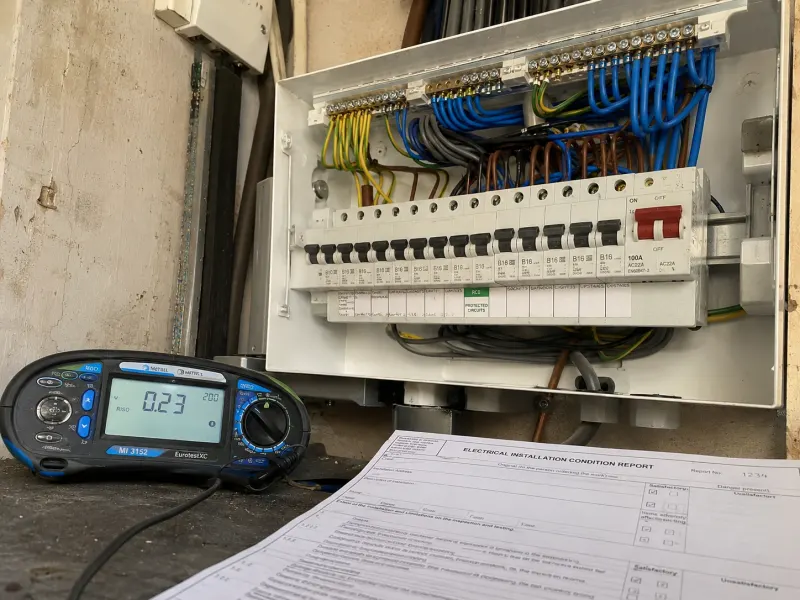
    An Electrical Installation Condition Report tests the fixed wiring and a sample of the sockets, lights and switches. It codes every observation. It is a report, not a certificate. A report carrying only improvement recommendations must be marked satisfactory.

    CostGuide price £100 to £330 plus VAT for a three-bed semi (Which?) Time4 to 8 hours for a three-bed semi (Which?)

  3. The work the report actually justifies

    Bonding first if it is missing, then shock protection, then the board itself if it is damaged, heat-distressed or beyond spare parts. Replacing a consumer unit is notifiable under the Building Regulations, so you should receive a compliance certificate within 30 days.

    CostGuide price £500 to £1,500 plus VAT for a new fuse box (Which?) TimeHalf a day to a day for a new fuse box (Which?)

Things that are usually fine

Straight from Aaron, who would rather tell you now than charge you later.

A fuse box with rewireable fuses is not a defect. The electrical industry's own best practice guide lists rewireable fuses, where they give adequate circuit protection, under a heading called Myths. What is a real finding is oversized fuse wire in them.

Aaron Foster, Fosters Electrics

A plastic consumer unit is not a fault in an existing home. The rule applies when a board is replaced, from January 2016 onwards. On an inspection it does not need to be recorded, unless it is under a wooden staircase or in your only escape route.

Aaron Foster, Fosters Electrics

A satisfactory report with a list of improvement recommendations is still a satisfactory report. Those are a shopping list, not a verdict.

Aaron Foster, Fosters Electrics

Electrician: who to call

How we choose.

Recommended

Referred by other local business owners we work alongside. Not an editorial review.

Show 2 other businesses serving Hendon

Also serving Hendon

Local businesses checked against public sources: their own websites and the public registers.

Tiers reflect membership of business groups we work alongside, not paid placement. Nobody pays to be listed.

Sometimes this is really a job for a different trade. We also refer to damp and timber specialist, and we say so when it is.

Questions people ask

What do C1, C2 and C3 mean on the report?
C1 is danger present, requiring immediate action. C2 is potentially dangerous, requiring urgent remedial action. C3 is improvement recommended, and it does not make a report unsatisfactory. FI means further investigation is required. If every observation on your report is a C3, the report itself must be reported as satisfactory.
Do I have to fix the C3 items?
No. C3 means improvement recommended and it has no effect on whether the report is satisfactory. Treat the C3 list as a prioritised wish list for when you next have an electrician in, and deal with anything coded C1 or C2 first.
Is it illegal to have a plastic fuse box?
No. The requirement for a non-combustible enclosure applies to new installations and to replacements, from 1 January 2016. It has never applied retrospectively. The current industry guide says it does not need to be recorded at all, unless it sits under a wooden staircase or in the only route out of the building, where it is an improvement recommendation (C3).
Did the survey actually test the electrics?
No. A standard home survey excludes electrical testing. When a surveyor writes that the consumer unit is old or dated, they are recommending that you get an inspection by an electrician. They have not found a fault, because they did not look for one.
What does an inspection cost and how long does it take?
A Which? survey of its Trusted Traders puts a report on a three-bedroom semi at £100 to £330 plus VAT, taking 4 to 8 hours. London prices are likely to be at the upper end. Owner-occupiers are advised to have one at least every 10 years. Landlords must have one every 5 years or at a change of tenant if that comes sooner.
Do I need a rewire?
Probably not, and the board alone is not evidence that you do. The things that genuinely point at a rewire are the cables, not the box: black rubber, lead or fabric-sheathed cable, round-pin sockets, braided flex from ceiling roses, switches mounted in skirting boards or a light switch on a bathroom wall. Without those, a recommendation to rewire on the strength of the board deserves a second quote.
How do I check the electrician is registered?
Search the Registered Competent Person Electrical register by postcode or company name. The government-authorised schemes for electrical work in dwellings are Certsure, which trades as NICEIC, along with NAPIT, BESCA, Blue Flame Certification and OFTEC. No single badge is the only valid one.
Someone offered a free fuse box safety check. Should I?
Ask one question first: will the findings come as coded observations on a proper inspection report? Genuine dangers have codes and written notification. A free check that produces a long list of worries and a single quote for a new board is a sales visit, not an inspection.
Do you cover Hendon and Mill Hill?
Yes. Hendon, Mill Hill, Finchley, Edgware, Golders Green, Colindale and Barnet are our core patch, with members across North London and Hertfordshire.
What if I am outside North London?
Tell us the postcode. If nobody we recommend covers your area we will tell you.
Further reading: Approved Document P: electrical safety in dwellings (GOV.UK), Registered Competent Person Electrical: find or check an electrician and Electrical Safety First: best practice guides, including the EICR codes.

Where we cover

Hendon, Mill Hill, Finchley, Edgware, Golders Green, Colindale, Barnet and the rest of North London and Hertfordshire. If you are outside this area, tell us where you are and we will point you to someone who covers you.

Not sure whether it is anything?

Tell us what has happened and your postcode. We tell you whether it needs anyone and what to do next. We reply by email, usually within one working day.

What's New in North London, every Thursday

What's opening, what's on and what's changing in Hendon. One free email.